Landscape Painted Rocks: Sunsets, Mountains and Night Skies
Paint a sunset landscape on a stone from back to front: sky bands, sun and hills, then tree silhouettes. Beach and night sky versions included.

Tutorial at a glance
Materials
- Acrylic craft paint: white, yellow, orange, pink, purple
- Black or very dark green paint for silhouettes
- Flat brush, about 1/2 in (12 mm)
- Round brush, size 4
- Small detail brush
- Pencil
- Jar of water and paper towel
- Clear sealer, brush-on or spray (optional)
Every simple landscape is painted from back to front: sky first, then whatever is far away, then whatever is close. Follow that order and each new layer covers the rough bottom edge of the one before it, so nothing has to be painted around.
The sunset below needs only three layers. The beach and night sky that follow use exactly the same sequence with different colors.
Choosing a stone and colors
Pick a wide, flat stone about 3 to 4 in (8 to 10 cm) across. A landscape needs horizontal room, and a flat face keeps the horizon from bending over a curve. Wash the stone, let it dry, and brush on a white base coat so the sky colors stay bright. The reasons a white underlayer helps are explained in layering paint on rocks.
For the sunset you need acrylic craft paint in yellow, orange, pink, purple, white and black or very dark green. Use a flat brush about 1/2 in (12 mm) wide for the sky, a round brush in size 4 for the hills, and a small detail brush for trees.
How to paint a sunset landscape
- Mark the horizon. With a pencil, draw a faint line across the stone about one third of the way up from the bottom. Everything above it is sky. Keeping the horizon below the middle gives the sky room for color.
- Paint the sky in horizontal bands. Starting at the horizon line, paint a band of yellow. Above it paint a band of orange, then pink, then a thin band of purple at the very top. Each band should be roughly the width of your flat brush. Carry every band around the sides of the stone.
- Soften the joins. While the paint is still wet, wipe the brush almost dry and stroke lightly back and forth along each line where two colors meet. A few passes are enough. Stop while you can still see separate bands, because overworking turns the whole sky one muddy color. Let the sky dry completely.
- Add the sun. Paint a half circle of white sitting on the horizon line, let it dry, then paint yellow over it. The white underneath keeps the yellow bright against the orange. Leave a hairline of white showing at the top edge if you want a glow.
- Paint the hills. Mix purple with a little white for a soft mountain color. With the round brush, paint a row of peaks whose bases sit on the horizon line and overlap the bottom of the sun. Vary the heights, and fill everything below the peaks down to the bottom of the stone. Let it dry.
- Add a nearer ridge. Paint a second, lower row of hills in straight purple across the bottom quarter. Darker color in front of lighter color is what makes the far mountains look distant.
- Paint the tree silhouettes. With the detail brush and black or very dark green, paint a thin vertical line for each trunk, rising from the bottom edge. Starting at the top of the line, dab short horizontal strokes that get wider as you move down, leaving small gaps between them. Place three to five trees of different heights, grouped toward one side, and join their bases with a dark strip of ground.
- Let it dry. Leave the stone until the thickest areas are dry all the way through, following the drying time on the paint label.

Tip
Acrylic paint dries quickly, so blend one join at a time. Paint the yellow and orange bands, soften that line, then add pink and soften the next. If a band dries before you blend it, repaint a thin strip of each color along the join and try again.
Two more scenes with the same method
Beach with waves
Put the horizon about halfway up. Paint the sky in pale blue fading to white at the horizon. Below it, paint a band of deep blue for the far water, then a lighter turquoise band nearer the shore, and finish with a curved strip of sand color across the bottom. When all of that is dry, use the detail brush and white to add two or three thin, wavy lines across the water and a broken white line where the water meets the sand.
Night sky with a moon
Cover the stone with dark blue, working a little purple or black into the top while the paint is wet. Let it dry. Paint a white circle or crescent for the moon, using two coats. For stars, dip a toothpick or the smallest dotting tool in white and touch it to the sky, varying the size and leaving some areas empty. Finish with a black silhouette of low hills or trees along the bottom edge. Tool sizes and paint consistency for clean dots are covered in dot painting on rocks.
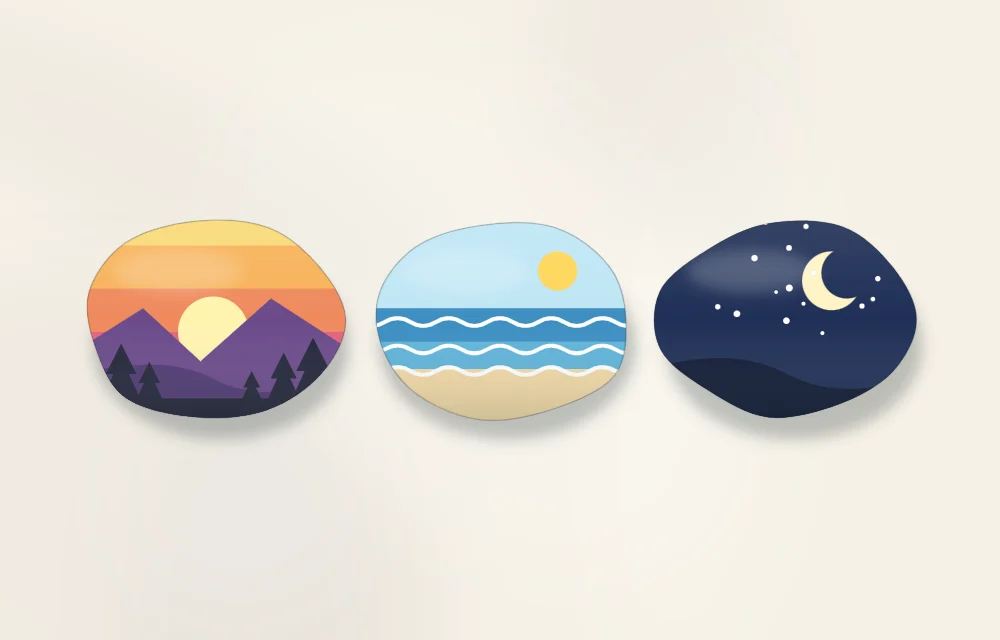
Layer order for each scene
| Scene | Layer 1: background | Layer 2: middle | Layer 3: foreground |
|---|---|---|---|
| Sunset | Bands of yellow, orange, pink and purple | Sun and purple hills | Dark tree silhouettes |
| Beach | Pale blue sky | Deep blue and turquoise water | Sand and white wave lines |
| Night sky | Dark blue sky | Moon and stars | Black hills or trees |
Common problems and fixes
- The sky turned brown or gray. Too much blending, or purple mixed directly into yellow. Keep orange and pink between those two colors, and stop blending early.
- The bands look like stripes. That is a perfectly good style, and many landscape stones use hard-edged bands on purpose. If you want a softer look, repaint the joins and blend while wet.
- The trees look like triangles. Leave uneven gaps between the branch strokes and let a few strokes stick out farther than their neighbors.
- Everything looks flat. Check the values: palest in the far distance, darkest up front. Choosing colors that keep that contrast is covered in color planning for rock painting.
- The silhouette edges are fuzzy. The layer below was not dry. More fixes like this are in common rock painting mistakes.
Sealing and display
Blended skies show scratches easily, so a clear sealer is worth considering once the paint is fully dry. Use a brush-on or spray product suited to acrylic paint and follow the manufacturer’s instructions for coats, drying time and ventilation. Spray sealers are a job for an adult. See how to dry and seal painted rocks for the full process.
A landscape stone sits well on a small stand or leaned against a book on a shelf. Outdoors, painted stones can fade, chip or wear and may need touching up.
Frequently asked questions
How do I blend sunset colors on a rock?
Paint two neighboring bands, then stroke lightly along the line where they meet with an almost dry brush while the paint is still wet. Work one join at a time, because acrylic paint dries quickly.
What do I paint first in a landscape?
Paint from back to front. The sky goes on first, then distant things such as the sun and hills, and the nearest things such as trees go on last so they overlap everything behind them.
Can I paint a landscape on a small rock?
Yes, but simplify it. On a small stone, use two or three sky bands, one row of hills and a single tree or two, and use a detail brush or a fine paint pen for the silhouettes.