How to Paint a Fish Rock: Simple Scales and Fins
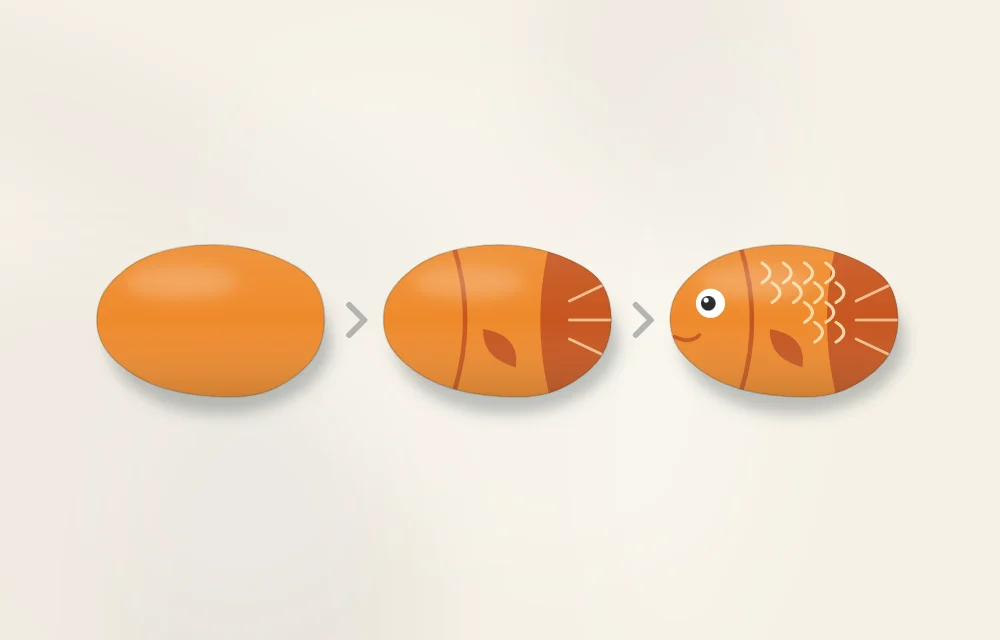
Paint an oval stone as a bright fish: one base color, a blocked-in tail and fin, then rows of staggered scales and a round eye.

Tutorial at a glance
Materials
- Acrylic craft paint: a base color, a darker or lighter accent color, white, black
- Flat brush, about 1/2 in (12 mm) wide
- Round brush, size 4
- Liner brush or fine acrylic paint pen
- Dotting tool or brush handle, and a toothpick
- Pencil, jar of water and paper towel
- Clear sealer, brush-on or spray (optional)
Turn an oval stone on its side and it is already most of a fish. The rounded end becomes the head, the narrower end carries the tail, and the long middle gives you room for the part that makes this project satisfying: rows of overlapping scales.
The design is painted flat on the top face of the stone. You lay down one base color, block in the tail and fin, then add scales and an eye. Scales look complicated but are only a repeated U-shaped stroke.
Stone and color choices
Pick a smooth oval stone about 3 in (8 cm) long with a fairly flat top. A stone that tapers slightly toward one end is ideal. Avoid deeply pitted surfaces, because thin scale lines will skip over the holes. If you are choosing from a bag of mixed stones, how to choose rocks for painting explains what to look for.
You need three paint roles, whatever colors you choose:
| Role | Example for an orange fish | Other combinations |
|---|---|---|
| Base color (body) | Bright orange | Teal, sunflower yellow, coral, sky blue |
| Accent color (tail and fin) | Darker red-orange | Navy on teal, orange on yellow, berry on coral |
| Scale color | Pale yellow or white | White on any mid-tone, or a darker shade of the base |
| Eye | White with a black pupil | Same for every fish |
The accent should be clearly darker or lighter than the base so the tail and fin stand out. For help pairing colors, see color planning for rock painting.
Materials
- One smooth oval stone, clean and dry
- Acrylic craft paint: a base color, an accent color, white and black
- A flat brush about 1/2 in (12 mm) wide
- A round brush, size 4
- A liner brush or a fine acrylic paint pen for the scales
- A dotting tool or brush handle, and a toothpick
- A pencil, water jar and paper towel
- Clear sealer, brush-on or spray (optional)
How to paint the fish
- Paint the base color. If the stone is dark and your base color is light, brush on a thin coat of white first and let it dry. Then cover the top and sides with the base color using the flat brush. Apply two thin coats, letting the first dry before the second. The whole stone is the body of the fish, so there is no background to paint.
- Sketch the layout. Lay the stone with the rounder end to the left. In light pencil, draw a curved line about a quarter of the way in from the left to separate the head from the body. At the right end, draw a sideways V for the tail. Add a small leaf-shaped fin in the lower middle of the body.
- Block in the tail. Fill the tail shape with the accent color using the round brush. Start each stroke where the tail joins the body and pull outward toward the edge of the stone, so the tips taper. Carry the color over the end of the stone.
- Block in the fin. Paint the side fin in the same accent color with two or three strokes that start at the front of the fin and sweep back. If you like, add a low ridge of the accent color along the top edge of the stone for a back fin. Let the accent color dry completely.
- Paint the first row of scales. Using the liner brush or paint pen in the scale color, start directly behind the head line. Draw a column of small U shapes, open side facing the head, from the top of the body to the bottom. Each U should be about as wide as a pencil eraser.
- Stagger the next rows. Begin the second column so that each U sits between two of the Us in the first column, like roof tiles or brickwork. Repeat toward the tail, letting the scales get slightly smaller as the body narrows. Work around the side fin rather than over it.
- Add fin and tail lines. With the same brush or pen, draw three or four thin lines along the tail, fanning out from the body, and two or three along the fin. These rays make the flat shapes read as fins.
- Paint the eye. On the head, press a white dot with the handle end of a brush. Let it dry, add a smaller black dot inside it, and finish with a pinpoint of white on the pupil using a toothpick.
- Finish the face. Add a short curved line at the front for a mouth and go over the head line once so it is crisp. Leave the stone to dry fully before sealing.
Tip
Work on the scales from the head toward the tail and from the top of the stone downward if you are right-handed, so your hand never rests on wet lines. Left-handed painters can flip the fish to face right.
Three ways to paint scales
The U-shaped line is the classic method, but it is not the only one. Choose whichever suits your tools.
- Line scales. Thin U shapes drawn with a liner brush or paint pen. Thin the paint slightly so it flows, and reload often so the lines stay even.
- Dot scales. Rows of dots made with a dotting tool, staggered from one row to the next. This is the easiest option for young painters and uses the same motion as dot painting on rocks.
- Stamped scales. Dip the rim of a drinking straw cut in half lengthwise into paint and press it onto the stone for a tidy half-circle. Practice on paper first to find the right amount of paint.
If a row drifts off course, let it dry, paint over that area with the base color, and redo it. Small differences between scales are not noticeable once the whole body is covered.
Painting a school of fish
Fish stones look best in a group. Paint several at once in assembly-line fashion: base coats on all of them, then all the tails, then all the scales. By the time you finish the last stone, the first is dry enough for the next layer.
Give each fish a different base color but keep the scale color the same, such as white, so the set looks related. Have them all face the same direction, or turn a single one the other way for a little humor. Thin vertical stripes or a few large spots can replace scales on one or two for variety.

Sealing and safe display
A clear sealer helps protect fine scale lines from rubbing off with handling. If you used paint pens, check that the sealer is compatible with them and apply it according to the manufacturer’s instructions, including drying times and ventilation. An adult should handle spray sealers. The guide on how to dry and seal painted rocks has more detail.
Watch out
Fish stones are for shelves, desks and plant pots. Do not put painted or sealed rocks in an aquarium, pond or any water that holds live animals, and keep them away from small children, who could choke on or throw them.
Outdoors, painted rocks can fade, chip or wear and may need touching up. For another animal built from simple layers, try the owl rock tutorial next.
Frequently asked questions
How do I paint fish scales on a rock?
Draw a column of small U shapes behind the head with a liner brush or paint pen, with the open side facing the head. Start the next column so each U sits between two in the column before it, and repeat toward the tail.
Can I put a painted fish rock in my aquarium?
No. Painted and sealed rocks are decorative and should not go in aquariums, ponds or any water with live animals. Display them on a shelf, a desk or in a plant pot instead.
What colors work best for a fish rock?
Choose a bright base color such as orange, teal or yellow, and an accent for the tail and fin that is clearly darker or lighter. White or pale yellow scales show up well on most mid-tone base colors.